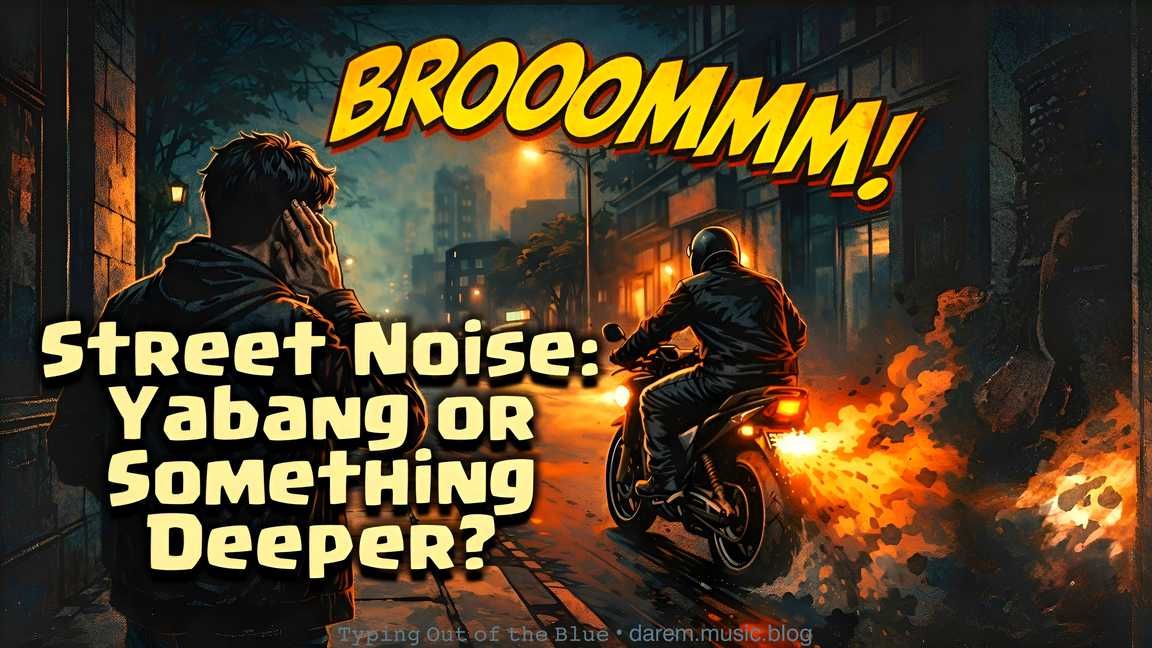
When a loud motorcycle or car passes by, most people have the same reaction: “That’s just showing off.” Attention-seeking, trying to look cool, no respect for others. And honestly, that reaction is valid, because that’s exactly what people experience.
On the street, the logic is simple. Quiet means respect. Loud means disturbance. End of discussion. That’s why most people don’t even ask why. They don’t need to. It’s already annoying.
But a small group of people—very few—still ask the question why. Not to excuse the behavior, but to understand it. That’s where psychology comes in.
From a psychological view, loudness isn’t judged first as arrogance. It’s seen as behavior. The questions become: What is the person seeking through noise? Sensation, control, emotional release, identity, belonging, or simple desensitization—being so used to noise that its impact on others is no longer noticed.
In psychology, noise is treated as a symptom, not immediately as a personality flaw. But let’s be clear—this doesn’t make the disturbance disappear. For the people affected, sleep is broken, focus is interrupted, and rest is stolen. All of that is real.
So two worlds collide. On the street, the judgment is simple: that’s just showing off. In psychology, the view is different: there’s something behind that behavior. Both perspectives make sense. They just use different lenses.
The problem is that once noise hits, there’s no room for encounter anymore. No listening happens. The body goes into defense mode—covering ears, irritation, tension. That’s where the conversation ends.
So this remains true. Most people see loud vehicles as arrogance. Only a few try to understand the psychology behind them—not because they are kinder, but because they are more curious. And in the end, no matter the explanation, noise is still noise. On the street, impact matters more than intention.
—
A human-centered study on street noise, behavior, and urban identity.
The Psychology of Street Noise
⌨ ᴛʸᵖⁱⁿᵍ ᴏᵘᵗ ᵒᶠ ᵗʰᵉ ʙˡᵘᵉ ᵈᵃʳᵉᵐ ᵐᵘˢⁱᶜ ᵇˡᵒᵍ