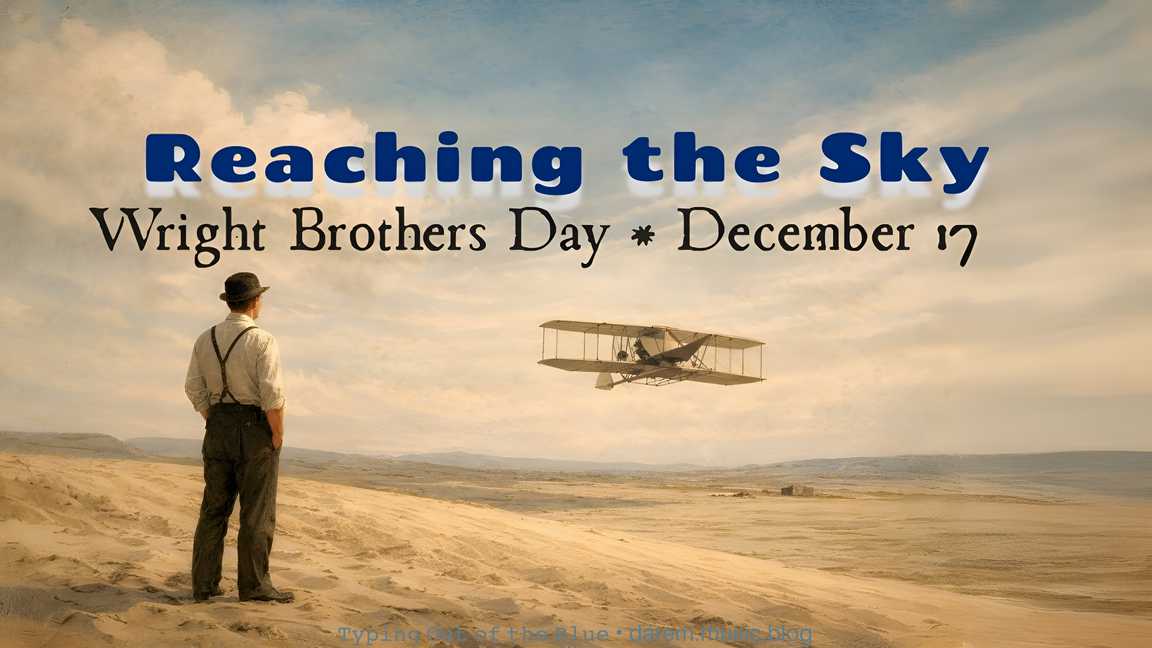
A story that begins long before engines, when the sky was still only a question.
A Plane Just Passed By • Darem Placer
Wright Brothers Day • December 17
As children, Wilbur and Orville Wright were already curious about flight. They watched birds closely, studied how wings moved, and wondered how balance worked in the air. A small toy helicopter given by their father once rose briefly, then fell. That simple moment stayed with them and sparked a lasting interest in how flight could be made real.
As they grew older, that curiosity turned into hands-on work. They built kites, tested gliders, and observed how air pressure and movement affected control. Their focus stayed clear: flight had to be stable and steerable. They believed an aircraft must be guided in the air, not just lifted from the ground.
On December 17, 1903, in Kitty Hawk, North Carolina, their work came together. They flew the first powered, heavier-than-air airplane that could take off, remain controlled, and fly repeatedly. This achievement defined what an airplane truly is.
The Wright brothers are considered the first inventors of the airplane because they turned early curiosity into a working system of flight. Their story shows how childhood wonder, when paired with patience and understanding, can change the course of history.
From swing to punk to playlists, cool stopped belonging to decades—and became personal.
Cool has never been one thing. It changes with time, shaped by pressure, boredom, rebellion, and overload. What people call cool is usually what feels right—or necessary—at a specific moment in history.
Sometimes cool is calm. Sometimes it is noise. Sometimes it is fashion, attitude, or refusal.
During the time of Jesus, there was no word for cool. Yet restraint was admired. Wisdom carried more weight than force. Meaning mattered more than volume. Authority did not need aggression, and silence itself could stop a crowd.
In the early centuries, cool meant discipline. Monks, scholars, and leaders were respected for control and focus. Too much emotion suggested instability. Calmness signaled strength.
During the Middle Ages, cool became tied to honor and duty. Reputation mattered. Emotion was managed, not displayed. Losing composure meant losing standing.
By the Enlightenment era, composure itself became cool. Calm speech, manners, and reason defined credibility. Losing control meant losing respect.
The word cool finally entered culture in the 1930s and 1940s through jazz. Musicians used it to describe calm confidence—effortless, controlled, and unbothered. Not flashy. Not desperate.
In the 1950s, cool went mainstream. James Dean, leather jackets, still faces. Detachment became the look. Being unaffected felt powerful.
That image was later distilled on television through The Fonz. Leather jacket. Relaxed posture. No explaining. No reacting. One word—“Hey!”—said enough. Control itself became cool.
By the 1960s, cool began shifting toward difference. Fashion got louder. Hair got longer. Television grew powerful, shaping what people copied. Cool meant you were not KJ. You did not simply follow your parents’ rules.
In the 1970s, cool became fashion plus freedom. Disco clubs, late nights, morning arrivals. Television defined what was “in.” This was also when the word baduy entered youth language. Being called baduy did not just mean unfashionable—it meant out of sync. Cool stopped being pure expression and became pressure.
The 1980s changed everything. Cool did not just get louder—it split. Punk, new wave, and pop spectacle existed side by side. MTV did not merely reflect cool—it dictated it. The same images repeated until they became truth. Punk noise was not empty—it was deliberate anger. DIY rejected polish. Raw meant honest. But now, to be cool, you had to choose a group.
In the 1990s, those divisions multiplied. Grunge, hip-hop, alternative, metal. In the Philippines, the band scene exploded. Cool meant you had a band. It didn’t matter how good you were. If you had a band, cool ka na. Music defined identity. Clothes followed sound. Belonging mattered more than mastery.
The 2000s broke the system. The internet removed gatekeepers. No need to wait for TV. No need for one authority. MP3s, file sharing, blogs, and early social platforms opened everything. Trends moved in real time. Choice exploded. Cool lost its center.
Businesses adapted fast. Instead of selling one trend per decade, they sold niches and identities. Cool became personal, not shared.
By the 2010s and 2020s, decade-specific cool faded completely. We can name earlier eras easily— 30s: swing 40s: bebop 50s: rock and roll 60s: psychedelic 70s: rock and disco 80s: punk, new wave, pop spectacle 90s: grunge, hip-hop, alternative, metal
But the 2000s, 2010s, and 2020s? No single sound. No common look. Nobody knows. Nobody really cares. Culture stopped moving together. Everyone lived in their own playlist.
The words change. The music changes. The business adapts.