What Is Amateur Radio

Before apps and networks, people were already talking through the air. And it still works today.

World Amateur Radio Day • April 18

Amateur radio began in the early 1900s, when wireless communication was still new and experimental. After the invention of radio in the late 19th century, curious individuals started building their own equipment and sending signals through the air. By the 1920s, it had grown into a worldwide activity, with operators connecting across countries and forming communities built on shared curiosity and skill.

Amateur radio, often called “ham radio,” is a way of sending messages using radio waves instead of the internet or mobile networks. People use special radios and frequencies to talk, send signals, or exchange data across cities, countries, or even continents.

It is not for business. It is not for profit. It exists for learning, experimenting, and connecting. No apps. No platforms. Just people talking through the air.

At first glance, it feels outdated. We already have smartphones, messaging apps, and fast internet. Everything is instant. Everything is easy.

But that is exactly why amateur radio still exists.

When disasters happen, networks fail. Cell towers go down. Internet connections disappear. In those moments, amateur radio keeps working. As long as there is power and a working radio, communication continues.

It also removes the middle layer. There are no servers, no subscriptions, no signal bars to worry about. One person sends a signal. Another person receives it. Direct. Simple.

Beyond function, it builds real skill. Operators learn how signals travel, how antennas work, and how to set up and fix their own equipment. It is not just tapping a screen. It is understanding what makes communication possible.

And then there is the reach. With the right setup, a signal can travel far beyond what you would expect. A voice can come from another country, answered by someone you have never met. No algorithm deciding who you hear. Just whoever is there.

Many also use it to serve. During emergencies and public events, amateur radio operators volunteer to help pass messages when regular systems are overloaded or unavailable.

In a world that depends on fast and fragile systems, amateur radio stays because it is reliable, independent, and human.

Old, yes. But not obsolete.

⌨ ᴛʸᵖⁱⁿᵍ ᴏᵘᵗ ᵒᶠ ᵗʰᵉ ʙˡᵘᵉ ᵈᵃʳᵉᵐ ᵐᵘˢⁱᶜ ᵇˡᵒᵍ
Voices Across the Field • Darem Placer

Radio and Artificial Intelligence

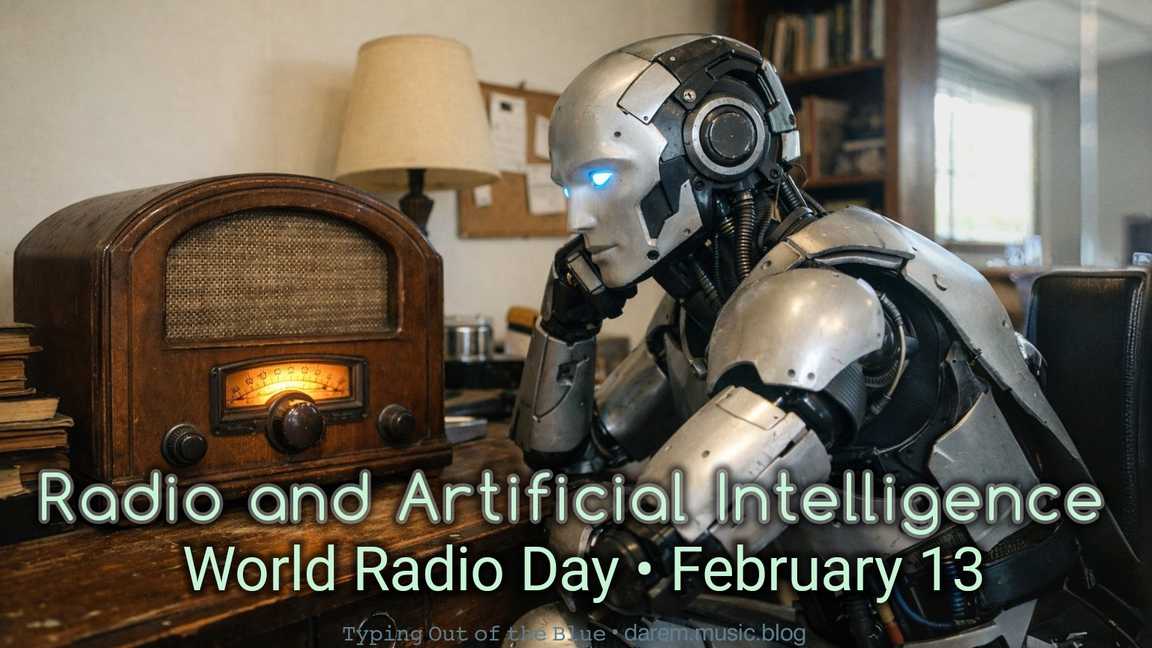
Radio does not trend like AI, but quietly, it continues to adapt—using new tools without losing the human voice at its core.

World Radio Day • February 13

Most people are not thinking about radio anymore.

It plays in the background of a bus ride. It runs quietly inside a small store. It comes alive during storms. But it rarely trends. It is not the center of online debate.

Artificial intelligence, meanwhile, dominates conversation. It writes articles, edits photos, answers questions, and generates voices. It feels loud, fast, and futuristic.

Putting radio and artificial intelligence in the same sentence sounds unusual at first. Radio feels old. AI feels new. One is associated with static and antennas. The other with algorithms and data centers.

Yet quietly, they are starting to meet.

Some radio stations now use AI to clean up noisy recordings. Others use it to transcribe interviews instantly. Small community broadcasters experiment with AI tools to organize archives or draft simple program outlines. There are no robot hosts replacing prime-time announcers. The changes are subtle and mostly technical.

Radio is not trying to reinvent itself with artificial intelligence. It is using it the way it once adopted cassette tapes, digital editing, and online streaming. As a tool.

Fewer people may actively talk about radio today, but when disasters interrupt power or data signals become unstable, radio still works. It does not need an app. It does not require an account. It simply transmits.

Artificial intelligence represents a new layer of media technology. Radio represents endurance.

They are not competitors. They are technologies from different eras learning to operate in the same space.

And perhaps that is what matters. Even the oldest forms of communication can adjust without losing their core. As long as there is a real voice behind the signal, radio will continue to speak and people will continue to listen.

Music video by The Buggles performing Video Killed The Radio Star. (C) 1979 Island Records Ltd.

⌨ ᴛʸᵖⁱⁿᵍ ᴏᵘᵗ ᵒᶠ ᵗʰᵉ ʙˡᵘᵉ ᵈᵃʳᵉᵐ ᵐᵘˢⁱᶜ ᵇˡᵒᵍ
The music of Darem Placer