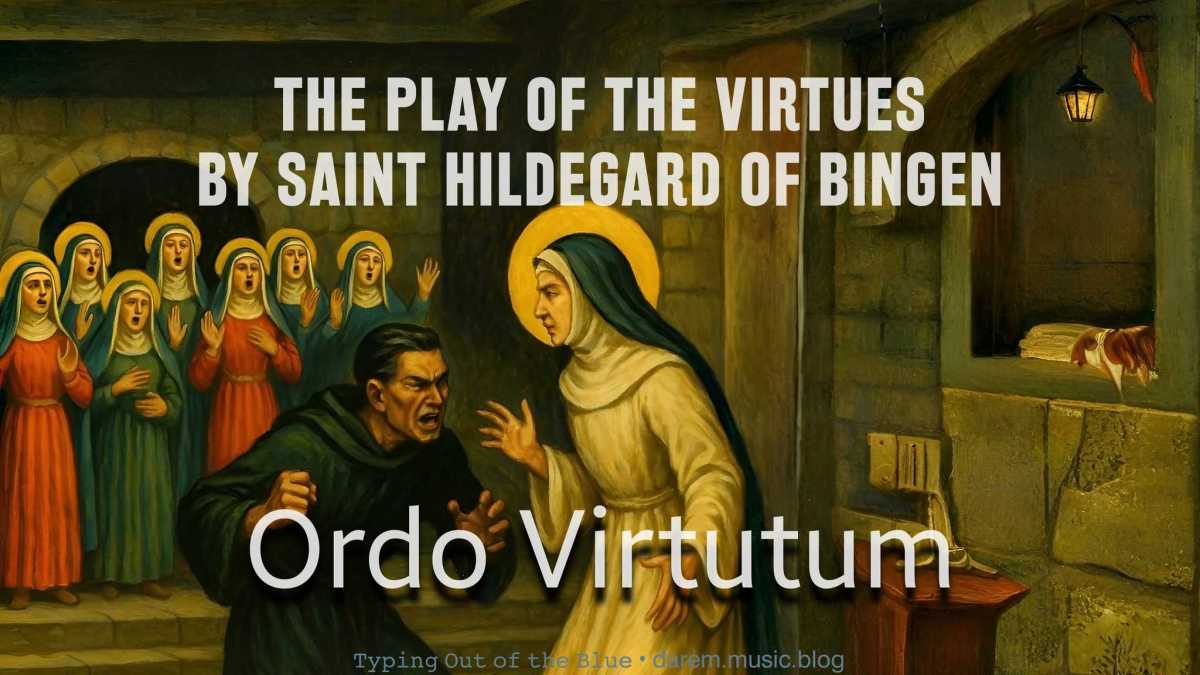
Ordo Virtutum

Not all voices can join the music. And in that silence, the story finds its sharpest truth.

The Play of the Virtues by Saint Hildegard of Bingen (A short retelling)

There’s this Soul. She’s hanging with the Virtues—Humility, Charity, Patience—the good crowd. They’re all singing together, and it’s not just music, it’s like the whole vibe of heaven. Everything clicks.

Then the Devil shows up. And here’s the funny part: he can’t sing. Not a single note. He just yells, spits promises, tries to sound cool. “Come with me, I’ve got freedom, I’ve got pleasure.” But it’s all noise. No rhythm, no tune.

The Soul falls for it. Steps out of the harmony, follows the noise. For a while, she thinks she’s winning. But the deeper she goes, the more empty it gets. Just chains. No beat.

Finally, she snaps out of it. “I wanna go back.”

The Virtues don’t shame her. They don’t say, “Told you.” They just welcome her back, and their music rises again. Stronger this time, bright enough to drown out the Devil’s noise. He rages, but he’s powerless—because noise can’t beat music.

And that’s how it ends: the Soul restored, the harmony alive, and the Devil stuck in silence.

Evil makes noise. Love makes music. You decide which crowd you wanna jam with.

We remember Saint Hildegard not only through her memorial on September 17, but also through her play that still sings of mercy and truth.

ᴛʸᵖⁱⁿᵍ ᴏᵘᵗ ᵒᶠ ᵗʰᵉ ʙˡᵘᵉ ᵈᵃʳᵉᵐ ᵐᵘˢⁱᶜ ᵇˡᵒᵍ

Written around 1151, Ordo Virtutum remains the earliest known morality drama with music.

WATCH: A full staged performance of Ordo Virtutum by Saint Hildegard of Bingen. Performed live at St. John’s Cathedral, Los Angeles, directed by Patricia McKee, Katina Mitchell, and Ned Tipton.

How One Sermon Changed a Nation

At Vézelay, the words of Saint Bernard of Clairvaux cut through pride and comfort, awakening the conscience of soldiers, nobles, and families. One sermon stirred tears, repentance, and action—showing how truth spoken with faith can change a nation.

The words of Saint Bernard of Clairvaux

“Take up the sign of the cross. If you must have glory, let it be God’s. If you seek riches, let it be in heaven. If you desire honor, let it be in the presence of the angels.”

That’s how Bernard began at Vézelay. He spoke about Christ—His wounds, His blood given for all, and the holy places left in ruin.

The words went straight to the heart. Soldiers na sanay sa patayan felt their guilt. Nobles na puro power and pleasure lang ang inisip saw how empty it all was. People realized: Christ gave everything for us, and we’ve given Him nothing.

It wasn’t just emotion—it was conscience. Tears came kasi tinamaan sila ng guilt and love at the same time, and they knew they had to change.

Right there, men tore strips of cloth to make crosses on their clothes. Families begged for Bernard’s blessing. Kahit sina King Louis and Queen Eleanor looked in awe as the crowd shifted from curiosity to conviction.

That day, it wasn’t fancy words that moved them. It was truth—and the power of a conscience finally awake before God.

Today, every August 20, the Church remembers Saint Bernard of Clairvaux—not just as a monk or abbot, but as a preacher whose words still challenge us. His life reminds us that when truth is spoken with faith, it can stir even the hardest heart and move a whole nation.


Typing Out of the Blue
daremplacer.com