Saint Faustina and the Divine Mercy
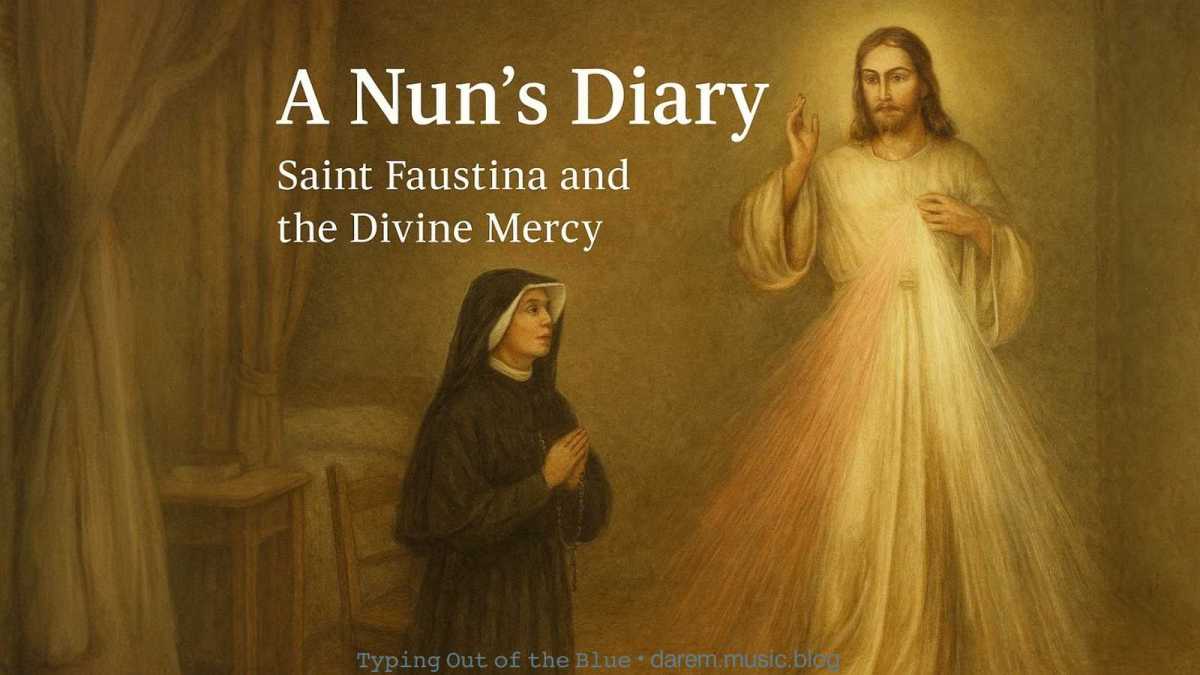
In 1931, within the quiet walls of a convent in Płock, Poland, a young nun named Sister Faustina Kowalska knelt alone in prayer. The silence of the night wrapped around her—until it broke with light.
Before her stood Jesus, clothed in a white garment, one hand raised in blessing, the other touching His heart. From His chest streamed two great rays—one red, one pale.
She listened as He said:
“Paint an image according to the pattern you see, with the signature: Jesus, I trust in You.” (Diary, 47)
The pale ray, He explained, stood for the Water that cleanses souls; the red ray for the Blood that gives them life. Though she knew nothing of painting, Faustina later worked with Father Michał Sopoćko and artist Eugene Kazimirowski to create the first Image of Divine Mercy in 1934.
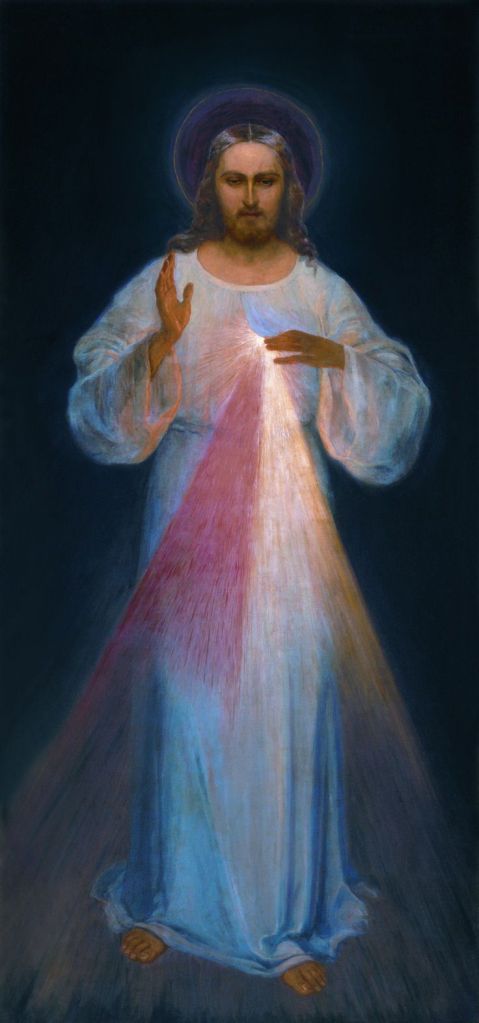
Jesus promised that through this image, He would pour out graces to those who trust in Him. The vision became the visible heart of a devotion that would soon embrace the world.
When the first painting was displayed in Vilnius in 1935, the words “Jezu, ufam Tobie”—“Jesus, I trust in You”—were not yet written on the canvas itself but placed on a small plaque beneath the image, as a signature of trust. Later versions, such as the 1943 painting by Adolf Hyła, began placing the words directly on the artwork, creating the familiar version we know today.
The Birth of the Chaplet
In 1935, in her small room in Vilnius, Lithuania, Faustina again saw a vision—this time of an angel of wrath ready to punish the world. Filled with compassion, she prayed for mercy, but her words felt too weak.
Then Jesus appeared once more—radiant, peaceful, merciful. He taught her a new prayer of atonement and trust, to be prayed on ordinary beads like those of the rosary.
She wrote His words in her Diary:
“Say unceasingly this chaplet that I have taught you. Whoever will recite it will receive great mercy at the hour of death.” (Diary, 476)
And again:
“Through this chaplet you will obtain everything, if what you ask for is compatible with My will.” (Diary, 1731)
From that moment, the Divine Mercy Chaplet became Heaven’s answer to human despair—a rhythm of hope born from the heart of Jesus Himself.
The Divine Mercy Chaplet
Sign of the Cross:
In the name of the Father, and of the Son, and of the Holy Spirit. Amen.
Opening Prayers:
You expired, Jesus, but the source of life gushed forth for souls, and the ocean of mercy opened up for the whole world. O Fount of Life, unfathomable Divine Mercy, envelop the whole world and empty Yourself out upon us. (Repeat three times) O Blood and Water, which gushed forth from the Heart of Jesus as a fountain of mercy for us, I trust in You.
On the Rosary Beads:
Pray one Our Father, one Hail Mary, and one Apostles’ Creed.
On the large beads:
Eternal Father, I offer You the Body and Blood, Soul and Divinity of Your dearly beloved Son, our Lord Jesus Christ, in atonement for our sins and those of the whole world.
On the small beads:
For the sake of His sorrowful Passion, have mercy on us and on the whole world.
After five decades:
Holy God, Holy Mighty One, Holy Immortal One, have mercy on us and on the whole world. (Repeat three times)
Closing Prayer:
Eternal God, in whom mercy is endless and the treasury of compassion inexhaustible, look kindly upon us and increase Your mercy in us, that in difficult moments we might not despair nor become despondent, but with great confidence submit ourselves to Your holy will, which is Love and Mercy itself. Amen.
These opening words were taught to Saint Faustina by Jesus in 1935, as recorded in her Diary, entries 1319–1321.
The Hour of Mercy
Jesus also asked Faustina to honor 3 PM, the hour of His death on the cross, as the daily Hour of Mercy.
He told her:
“At three o’clock, implore My mercy, especially for sinners… This is the hour of great mercy for the whole world.” (Diary, 1320)
At this time, believers pause—even for a moment—to recall His Passion, pray the Chaplet if possible, or simply whisper: “Jesus, I trust in You.”
Three o’clock is not just a number on the clock. It is the reminder of the moment when mercy broke open for all humanity.
ᴛʸᵖⁱⁿᵍ ᴏᵘᵗ ᵒᶠ ᵗʰᵉ ʙˡᵘᵉ ᵈᵃʳᵉᵐ ᵐᵘˢⁱᶜ ᵇˡᵒᵍ