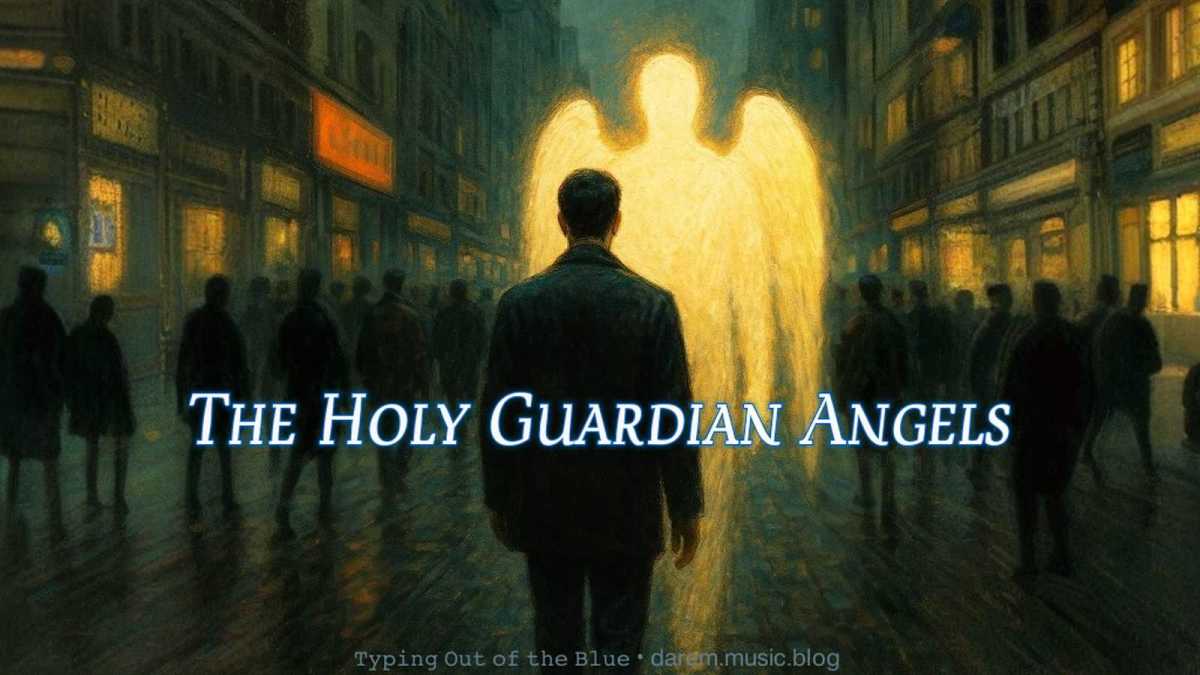
The Holy Guardian Angels

Unseen but never absent—guardian angels remind us God never leaves us to walk alone.

We often think we walk through life alone—but heaven says otherwise. Each of us has a guardian angel, a companion assigned by God Himself. Not a storybook character with wings and glitter, but a real presence guiding, warning, and protecting us.

This isn’t a cute superstition. The Bible speaks of it clearly: “For He will command His angels concerning you to guard you in all your ways” (Psalm 91:11). Jesus Himself pointed to the truth when He said that children’s angels are always before the face of the Father.

The feast of the Holy Guardian Angels was set for the whole Church in 1670 by Pope Clement X. Since then, every October 2 is a reminder that we are never left on our own. God’s love is constant, and He sends His angels to prove it—quiet protectors who walk beside us, even when we don’t notice.

Many of us first learned about guardian angels as kids, praying “Angel of God, my guardian dear…” every night. If we had carried that same faith into adulthood, maybe life would be less reckless, maybe we’d be wiser. But people often tag it as a childish thing and let it fade, as if angels retired when we grew up. Truth is, they never stopped watching over us—we just stopped believing.

The lesson is simple but deep: we’re not abandoned. The presence of our guardian angel invites us to trust more, fear less, and choose the better road. It’s God’s way of saying, “I’ve got you covered.”

The prayer many forgot, though the angels never forgot about us.

Angel of God, my guardian dear,
to whom God’s love commits me here.
Ever this day, be at my side,
to light and guard, to rule and guide. Amen.

My Guardian Angel • Darem Placer

Listen on Apple Music, Apple Music Classical, and YouTube Music

Praying Without Words includes My Guardian Angel

ᴛʸᵖⁱⁿᵍ ᴏᵘᵗ ᵒᶠ ᵗʰᵉ ʙˡᵘᵉ ᵈᵃʳᵉᵐ ᵐᵘˢⁱᶜ ᵇˡᵒᵍ

Why World Contraception Day Feels Different for Catholics

World Contraception Day sparks real concern—but Catholic teaching points to a vision where love and life stay whole.

Every September 26, World Contraception Day pops up worldwide, reminding people of choices, planning, and awareness. For most, it’s about preventing unplanned pregnancies, promoting safe practices, and protecting women from health risks. Behind it is a desire to ease the burden of families, lessen the cycle of poverty, and keep both mothers and children safe.

The challenge of teen pregnancy and family hardship is real. For many, the solution is to cut off the possibility through contraception. From the Catholic perspective, however, the response lies in formation—teaching responsibility, self-control, and chastity before marriage, and offering natural family planning within marriage. The vision is not to block fertility, but to respect it, guiding choices in a way that safeguards dignity.

The Church teaches that love and life can never be split apart without losing something essential. Contraception interrupts the wholeness of God’s design. That’s why Humanae Vitae emphasizes that marital love is always meant to remain open to life.

The alternative offered is not a rejection of planning, but a call to discernment—a way of respecting the body’s rhythm and practicing responsible parenthood without closing the door on fertility.

World Contraception Day, then, becomes a moment to reflect. The concern for health and family is shared, yet Catholics hold to another vision: caring for life and planning for the future while staying rooted in God’s creative design.

Following Catholic teaching takes nothing away—ignoring it puts at risk everything that gives life its meaning.

ᴛʸᵖⁱⁿᵍ ᴏᵘᵗ ᵒᶠ ᵗʰᵉ ʙˡᵘᵉ ᵈᵃʳᵉᵐ ᵐᵘˢⁱᶜ ᵇˡᵒᵍ