Alfred Nobel: The Man Behind the Nobel Prize

A mistaken obituary pushed him to create a prize that celebrates progress and peace.

Nobel Day • December 10

Alfred Nobel was a Swedish inventor and businessman. He became known for creating dynamite, a powerful explosive first used in construction before the military later adopted it for warfare. This added controversy to his name.

In 1888, Nobel’s older brother Ludvig died in France. A French newspaper made a mistake and published an obituary for Alfred instead of Ludvig.

The obituary called Alfred Nobel “the merchant of death,” claiming he made his fortune by creating tools for killing. It surprised Nobel and made him think about how people might remember him.

A few years later, in 1895, Alfred Nobel wrote his final will. He directed most of his fortune to create a set of yearly awards for people who make important contributions to humanity. He personally chose the categories of physics, chemistry, medicine, literature, and peace. These awards became the Nobel Prizes, meant to support discoveries and efforts that improve life and promote understanding between nations.

Alfred Nobel died in 1896, and the first Nobel Prizes were awarded in 1901.

The whole tradition began with one man deciding that his name should be linked to progress, learning, and peace rather than conflict.

⌨ ᴛʸᵖⁱⁿᵍ ᴏᵘᵗ ᵒᶠ ᵗʰᵉ ʙˡᵘᵉ ᵈᵃʳᵉᵐ ᵐᵘˢⁱᶜ ᵇˡᵒᵍ

Merely Christmas • Darem Placer
Out this season on Bandcamp.

Saint Nicholas and How He Turned Into Santa

A bishop shaped the roots of Santa through simple acts, lasting stories, and a tradition that grew across the world.

Saint Nicholas lived in the early 300s in Myra, a port city in southern Turkey. He served as a bishop, and people around him saw a leader who carried faith, strength, and generosity in a natural way.

Picture a friend who helps right away. That was Nicholas. A family reached a hard stretch, and he placed gifts in their home during the night. A person faced heavy pressure, and he stepped in with steady courage. He gave with intention, and people felt the impact. His actions stayed in memory, and stories about him moved from place to place. He offered material gifts—coins, food, simple essentials—and each one carried deeper value because it helped people rise again with real hope.

As these stories traveled across Europe, each culture shaped his name in its own style. In the Netherlands, he became Sinterklaas (their form of “Saint Nicholas”). Dutch settlers then sailed to New York and brought the name with them. English speakers formed a new version from it, and Santa Claus emerged (the English form of “Sinterklaas”).

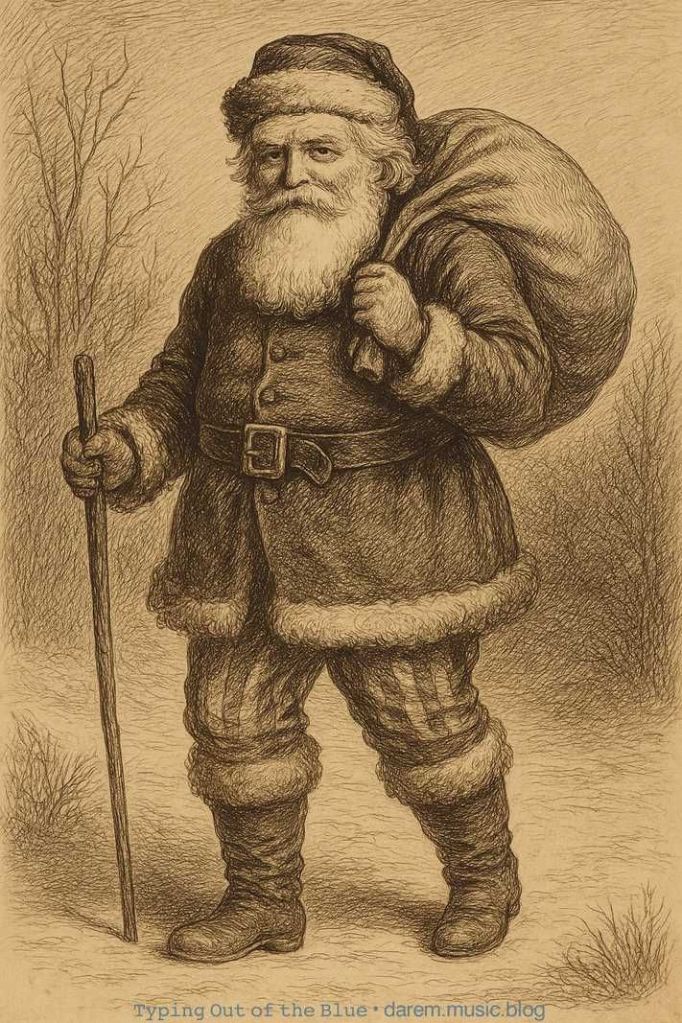
Santa as drawn in the 1860s, during the years when his modern form started to take shape.

By the 1800s, artists and writers shaped Santa’s look, and many illustrators used red because the color stood out on printed pages and matched old European images of Nicholas in red bishop robes. The shade carried well across holidays and became the familiar image the world now knows.

Santa grew from that one man—Nicholas, the figure behind the Christmas carol Jolly Old Saint Nicholas, a bishop whose day-to-day kindness shaped a tradition that reached the entire world.

Jolly Old Saint Nicholas • Darem Placer
Merely Christmas includes Jolly Old Saint Nicholas. Out this season on Bandcamp.

⌨ ᴛʸᵖⁱⁿᵍ ᴏᵘᵗ ᵒᶠ ᵗʰᵉ ʙˡᵘᵉ ᵈᵃʳᵉᵐ ᵐᵘˢⁱᶜ ᵇˡᵒᵍ