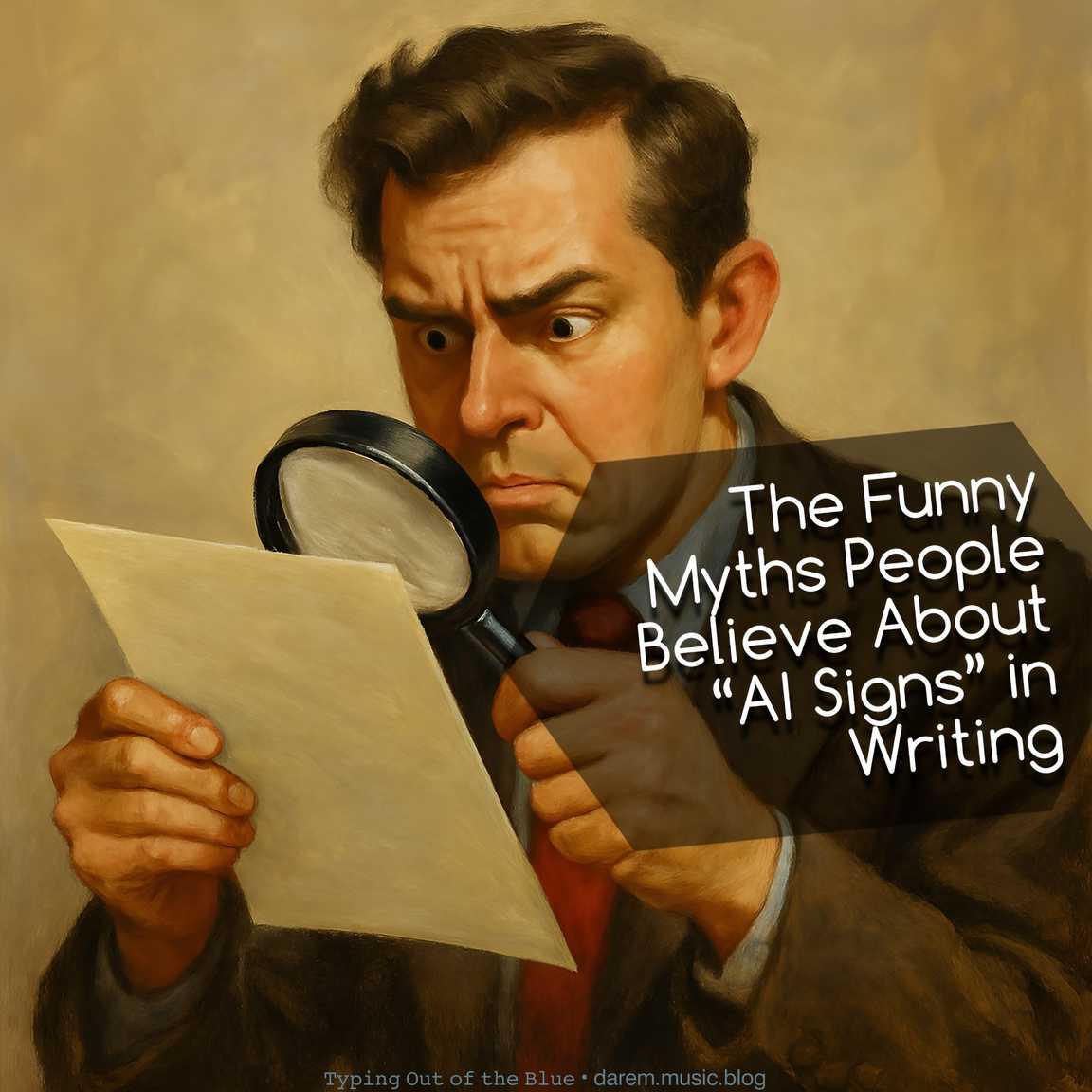
Some ideas on the internet spread like wildfire, even if they make zero sense. And one of the funniest? The belief that you can “detect AI writing” by looking for random little clues—like you’re some kind of digital Sherlock Holmes.
Let’s clear it up in the most respectful-but-come-on way: most of these so-called “AI signs” are nonsense.
1. “If you use an em dash, you’re AI.”
This one deserves an award for creativity.
Writers have used em dashes for centuries. Novelists, journalists, bloggers—everyone.
If an em dash automatically means “robot,” then every classic author from the last hundred years was apparently a transformer in disguise. Makes no sense.

2. “Perfect grammar means AI.”
Right. So everyone who proofreads is now a machine.
Humans can write clean when they feel like it.
AI can write messy if you tell it to.
Grammar isn’t DNA.
3. “Organized paragraphs mean AI.”
So if your thoughts aren’t scattered like confetti, you’re not human?
There are people who write neatly on purpose. They exist. Promise.
4. “Certain phrases are AI trademarks.”
People online keep listing words like “furthermore,” “ultimately,” “on the other hand.”
Newsflash: humans wrote those.
AI didn’t descend from the clouds and claim them as trademarks.
5. “Neutral tone = AI.”
Some humans are naturally calm and factual.
Not everyone writes like they’re arguing on social media.
Neutral tone doesn’t equal robot.
6. “If there’s no typo, it’s definitely AI.”
Imagine telling a student, “Your essay has no mistakes… you must be a cyborg.”
Humans can use spellcheck.
Typos aren’t proof of humanity.
7. “AI text has hidden watermarks when copied.”
This one is peak internet paranoia.
Plain text cannot carry invisible watermarks.
No secret barcode. No hidden tag.
Just letters from A to Z.
It’s like claiming your grocery list is wiretapped.
8. “Too many synonyms = AI.”
Writers switch words all the time.
That’s called style, not circuitry.
9. “If it’s not emotional, it’s AI.”
Some people are factual. Some people are expressive.
That’s personality, not evidence.
10. “If it sounds too balanced, it must be AI.”
Yay! The fear of structure.
Sometimes humans can think clearly. It’s allowed.
So what actually gives away AI writing?
Not punctuation.
Not clean grammar.
Not em dashes.
It’s tone.
It’s repetition.
It’s when the writing feels empty even if it’s long.
And even that isn’t perfect science.
Because once a human edits or injects their own voice, the whole discussion becomes pointless.
AI doesn’t define the tool. The writer defines the output.
Well…
People online love inventing secret rules about what “proves” a piece was written by AI. But most of those ideas collapse the moment you think for five seconds. Writing isn’t a crime scene. There are no magic fingerprints hiding in punctuation or grammar. Sometimes a sentence is just a sentence.
If someone insists your work is AI-made just because it’s clean or organized, let them. It says more about their reading skills than your writing skills.
And honestly—if your whole identity falls apart because someone used an em dash, maybe the robot isn’t the writer. 😁
⌨ ᴛʸᵖⁱⁿᵍ ᴏᵘᵗ ᵒᶠ ᵗʰᵉ ʙˡᵘᵉ ᵈᵃʳᵉᵐ ᵐᵘˢⁱᶜ ᵇˡᵒᵍ
