Some of our favorite everyday foods may vanish as the planet heats up—changing not just taste, but culture itself.
When we walk into a grocery store or grab food from a small stall, it feels like the choices will never run out. Bread, coffee, peanuts, grapes—always there, always cheap. But climate change is quietly shaking the roots of how these foods grow. One day, the shelves might look very different.
Here are 4 foods that could slowly slip away:
1. Wheat
Bread, noodles, pastries—wheat is everywhere. It grows best in mild weather, but too much heat can crush harvests. As the Earth warms, lands that used to be perfect for wheat might no longer work. Prices go up, and the basics we depend on could fade from our plates.
2. Coffee
Coffee is picky. It needs the right mix of cool air, shade, and altitude. Rising heat ruins the flavor, makes beans ripen too fast, and shrinks the space where coffee can grow. By 2050, many top coffee regions might not survive. Imagine mornings without your favorite cup—or paying way more for it.
3. Peanuts
Peanuts can take the heat, but only to a point. Once temps climb too high, the plants look healthy but don’t make enough nuts. Rain that comes too much or too little also hurts them. Scientists are racing to grow tougher peanuts, but time is short. Even peanut butter might become a luxury.
4. Grapes
Grapes feed both our tables and our wine glasses. They’re sensitive—too much heat and they ripen too soon, losing flavor. Some vineyards may vanish, others may move to cooler places. But the taste, the culture, the traditions—they’ll never be quite the same.
It Really Matters
These aren’t just foods—they’re memories, livelihoods, and part of how we live together. If we lose them, it’s not only our taste buds that suffer but also our culture and economy.
We can still do something:
• Support farmers using sustainable ways
• Use energy and resources wisely
• Push leaders to act faster on climate solutions
And here’s one step we can take right now: add our voice to the Renewable Energy Petition. It’s a way to tell world leaders we expect them to act—to protect both the planet and the foods we love.
When life feels too heavy, we can lift our eyes and find that help often arrives in ways we least expect.
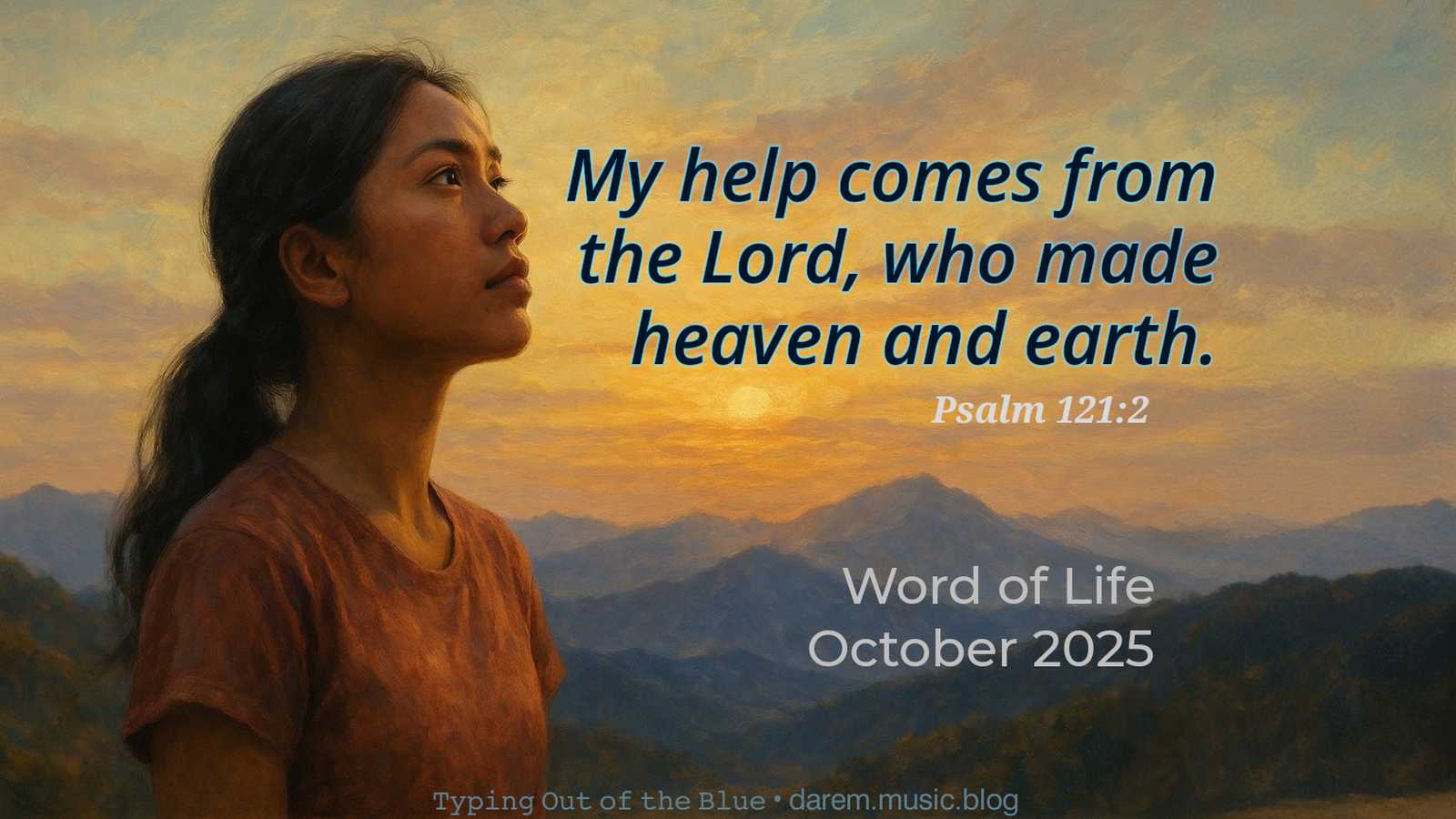
“My help comes from the Lord, who made heaven and earth.” (Ps 121:2)
Who hasn’t, at some point in life, felt overwhelmed and unable to go on?
The author of Psalm 121 expresses that same feeling as he faced difficult circumstances and wondered where he could get the help he needed.
His answer was to affirm his faith in God, in whom he trusts. The conviction with which he speaks of the Lord—who watches over and protects each individual and the entire people—reveals a certainty that obviously came from a deep personal experience.
“My help comes from the Lord, who made heaven and earth.”
The rest of the psalm is, in effect, a proclamation of our powerful and loving God, who created all that exists and watches over it day and night. “He will not let your foot be moved; He who keeps you will not slumber,” the psalmist assures us, as if eager to convince the reader. Overwhelmed with problems, the author “lifted up his eyes” and searched for a foothold outside and beyond his immediate surroundings—and found the answer.
He experienced that help comes from the One who conceived and gave life to every creature, continues to sustain them in every moment, and never abandons them. He firmly believes in God, who watches over His people day and night—He is “the guardian of Israel”—to the point that he cannot help but share this conviction with others.
“My help comes from the Lord, who made heaven and earth.”
Chiara Lubich asserts that in moments of uncertainty, anguish, and suspension, “God wants us to believe in His love and asks us to trust Him. (…) He wants us to take advantage of these painful circumstances to show Him that we believe in His love. And that means having faith that He is our Father and cares for us. We have to cast all our worries on Him, to unload them onto Him.”
But how does the help that comes from God reach each one of us? Scripture recounts many episodes in which God’s love becomes concrete through the actions of men and women, such as Moses, Elijah, Elisha, or Esther, who were called to be instruments of divine care for the nation or for specific individuals.
If we too “lift up our eyes,” we will recognize the actions of people who, consciously or unconsciously, come to our aid. We will be grateful to God, from whom all good things ultimately come (He created the human heart), and we will be able to bear witness to others of His love.
It is certainly harder to see this if we are closed in on ourselves and, in difficult moments, focus only on how we can resolve things with our own efforts. When, instead, we open ourselves up, look around, and lift our eyes, we discover that we too can be instruments of God’s providence for His children. We become sensitive to the needs of others and can be a precious help to them.
“My help comes from the Lord, who made heaven and earth.”
Roger, from Costa Rica, recounts:
“A priest I know told me someone would stop by to pick up some adult diapers we had made available through the solidarity group I belong to, knowing that one of his parishioners needed them. While I was waiting, I saw one of my neighbors pass by. I knew she was going through a very difficult moment financially and so I gave her the last seven eggs I had, along with some other food items. She was surprised and told me that in fact she had nothing left to feed her husband and children. I reminded her of Jesus’ invitation, ‘Ask, and it will be given to you,’ emphasizing how attentive God is to our needs. She went home feeling very happy and grateful to God.
In the afternoon, the person sent by the priest arrived. I offered him a cup of coffee. He was a truck driver, and as we chatted, I asked him what he was transporting. ‘Eggs,’ he replied, and then gave me thirty-two as a gift!”
Prepared by Silvano Malini and the Word of Life team —
Reflection
There are moments when life feels too heavy. We may run out of strength, out of choices, out of hope. In those moments, the psalm reminds us: “Lift your eyes.”
It invites us to look beyond the noise and the limits around us. The One who made everything is still here—and He cares for us.
Many times, His help reaches us through people: a kind word, a shared meal, a hand on our shoulder. Small gestures that carry great meaning.
So when fear comes, let us lift our eyes.
When we see someone in need, let us be the help.
And when doubt grows, let us place our trust in the Maker of heaven and earth.