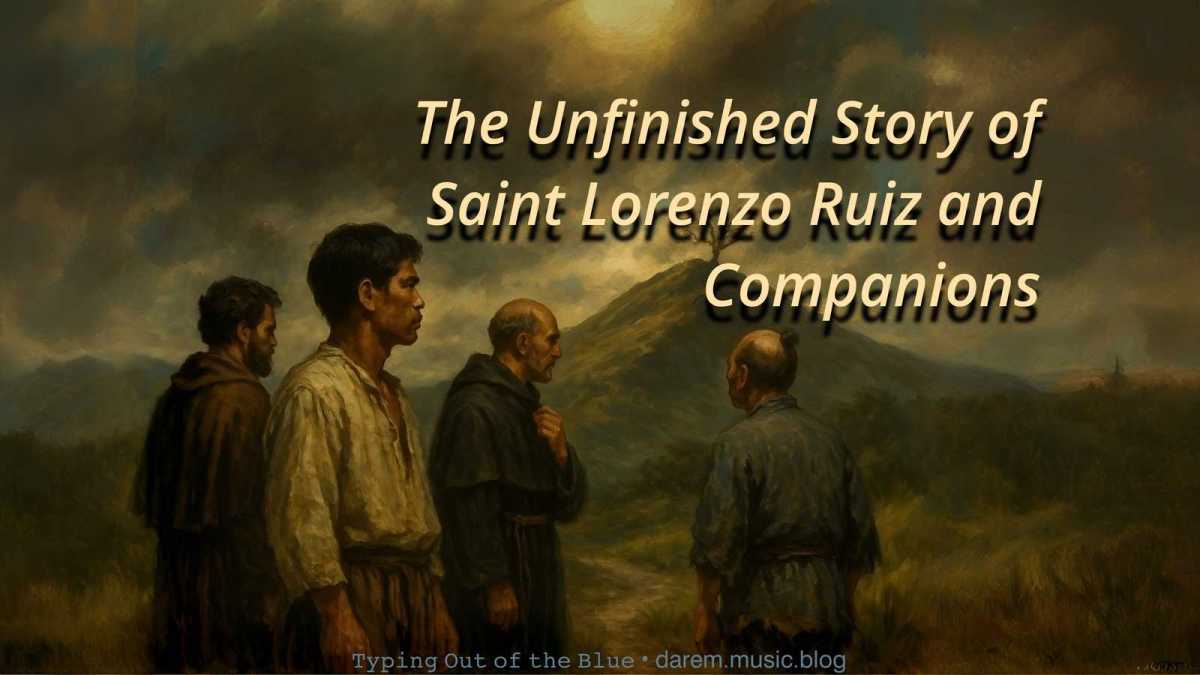
When people hear the name Lorenzo Ruiz, they usually recall the basics: first Filipino saint, martyred in Japan, feast on September 28. But his story is not clean or polished. It is messy, unfinished, and real.
An Ordinary Man
Lorenzo was born in Binondo around 1600. He was a husband, father of three, and a calligrapher for the Dominicans. His careful handwriting filled church records, yet none of his own words remain. No diary, no letters. Everything we know comes from others.
The Accusation
In 1636, Lorenzo was accused of killing a Spaniard. No proof was ever found, and many believe the charge was false. Still, it was enough to put his life at risk. He joined Dominican missionaries leaving Manila, hoping to escape the danger.
Into Japan
The ship brought him to Japan, then ruled by the Tokugawa shogunate. There, Christianity was banned, and believers faced torture and death. If he had fled an accusation in Manila, he now stood in a land where his faith itself was treated as a crime.
Not Alone
Lorenzo was not alone. With him were others whose names are often forgotten:
• Antonio Gonzalez, a Spaniard who once escaped persecution but chose to return.
• Guillaume Courtet, a French priest who entered Japan in disguise but was exposed when his smooth hands showed he was no laborer.
• Lazaro of Kyoto, a Japanese leper who refused to hide and stayed with the missionaries to the end.
They came from different nations, but they faced the same fate.
The Pit
On September 29, 1637, Lorenzo was tortured by being hung upside down in a pit. It was a slow, crushing death meant to force him to deny his faith. Many could not endure it. He did not give in. His last words were clear and strong:
“I am a Catholic and wholeheartedly do accept death for God; had I a thousand lives, all these to Him shall I offer.”
What We Do Not Know
His wife and children disappear from history. No names remain, no endings recorded. In 1981, he was beatified in Manila—the first time a beatification was held outside Rome. Six years later, in 1987, he was canonized in Rome. Today, many migrants see in him a patron: a man who left home and never returned.
Saint Lorenzo Ruiz and his companions were not perfect heroes. They were ordinary people caught in harsh times. But when the final choice came, they chose faith over fear.
That choice is what turned an ordinary father—and a scattered group of companions—into saints. Their story still leaves us with a question: when our own trial comes, what will we stand for?
ᴛʸᵖⁱⁿᵍ ᴏᵘᵗ ᵒᶠ ᵗʰᵉ ʙˡᵘᵉ ᵈᵃʳᵉᵐ ᵐᵘˢⁱᶜ ᵇˡᵒᵍ

Listen on Apple Music, Apple Music Classical, and YouTube Music
